

Comprehensive Marketing Solutions for your Business Needs

Black Friday 2026: Record Spending, Smarter Shoppers and the Rise of AI

Black Friday 2026: Record Spending, Smarter Shoppers and the Rise of AI Australians are tipped to spend a record $7.2 billion this Black Friday weekend. But the biggest story isn’t how much we’re spending. It’s how the way we shop is changing. Black Friday has become one of the biggest events on Australia’s retail calendar, and 2026 is shaping up to be another record-breaking year. According to new research from the Australian Retail Council (ARC) and Roy Morgan, Australians are expected to spend $7.2 billion across Black Friday and Cyber Monday, from 27 to 30 November 2026. That’s a 5.5% increase on last year. But there’s something particularly interesting hiding behind that enormous figure. Fewer Australians are planning to shop the sales, yet those who participate are expected to spend more. And increasingly, artificial intelligence is helping them decide where to spend their money. For Australian businesses, these changing behaviours could have implications that extend well beyond one weekend of sales. Fewer Shoppers, Bigger Budgets The ARC and Roy Morgan research suggests approximately 5.8 million Australians intend to participate in Black Friday this year, compared with around six million in 2025. Despite that decrease, the average planned spend has increased to $920 per shopper, up 14.4% from last year. Almost one in three participating shoppers expects to spend at least $1,000. At first glance, record spending might suggest Australians are feeling increasingly confident about their finances. But the reality is more complicated. With cost-of-living pressures continuing to influence household budgets, many consumers are becoming more deliberate about their purchases. Rather than buying whenever something catches their attention, they’re planning ahead, researching their options and waiting for opportunities to secure better value. In fact, 58% of participating shoppers identify low prices as a key motivation, while 39% are shopping to save money on Christmas presents. Black Friday isn’t necessarily encouraging people to spend without thinking. For many, it’s becoming part of a carefully planned shopping strategy. What Does This Mean for Australian Businesses? For retailers, the opportunity isn’t simply to offer the biggest discount. It’s to understand how customers make purchasing decisions. Someone visiting your website during Black Friday may have been considering their purchase for several weeks. They might have already compared competing products, read customer reviews and worked out exactly what they’re prepared to spend. By the time they reach your business, they may be looking for reassurance rather than persuasion. That changes how we should think about marketing during major sales periods. Businesses that communicate their value clearly, demonstrate reliability and make the buying process straightforward may be better positioned to convert interested shoppers. And while discounts can encourage purchases, they’re not always the only deciding factor. Customer service, convenience, product quality, delivery options and trust all have a role to play. For smaller Australian businesses, this is particularly important. Competing with major retailers purely on price isn’t always commercially sustainable. But communicating what makes your business worth choosing is something every business can work on. AI Is Becoming Part of the Shopping Journey Perhaps the most significant finding in this year’s research is the growing role of artificial intelligence. One in four participating Black Friday shoppers surveyed plans to use an AI chatbot to research products or find deals. Of those planning to use AI, 72% say it will be their first time doing so for Black Friday. That’s a development Australian businesses should pay attention to. Until recently, much of the conversation about AI in marketing has centred on how businesses can use it to create content, improve productivity and automate everyday tasks. Now we’re seeing another side of the equation. Customers are using AI to help them make purchasing decisions. Instead of visiting multiple websites individually, a shopper might ask an AI assistant to compare products, explain differences, identify suitable options or help find competitive prices. This doesn’t mean traditional search engines are disappearing, or that AI recommendations are always accurate. But it does mean businesses need to consider another way customers might discover their products and services. Is Your Business Ready for AI-Assisted Shopping? For businesses, preparing for this change starts with something surprisingly straightforward: making information easy to find and understand. If an AI assistant is helping someone research a product, the quality and accessibility of online information can influence what it is able to retrieve and explain. That makes several established marketing practices increasingly valuable: Accurate product and service information: Clear descriptions, specifications, pricing and availability help customers understand what you’re offering. A well-maintained website: Organised, accessible content makes it easier for search engines, customers and compatible AI tools to interpret your business information. Credible customer reviews: Genuine feedback helps potential customers assess quality, reliability and customer experience. Consistent business details: Keeping contact information, locations and business profiles up to date reduces confusion. Clear competitive advantages: Explaining why your offering is different helps customers make meaningful comparisons beyond price. None of these actions guarantees that an AI chatbot will recommend your business. But they’re sensible foundations for online visibility, regardless of how someone discovers you. And importantly, they also make the experience better for customers who prefer to research and shop without AI. Trust Still Matters More Than Ever Technology is making it easier for consumers to compare their options. But having more information doesn’t necessarily make purchasing decisions easier. Customers still need to decide which businesses they trust. An AI assistant might help someone narrow down their options, but the business itself still needs to deliver on its promises. That includes providing accurate information, offering dependable service and creating a positive customer experience. It’s a useful reminder that new technology doesn’t eliminate the fundamentals of good marketing. If anything, it makes them more visible. A strong reputation, a compelling offer and a trustworthy brand remain valuable, whether a customer finds your business through Google, social media, word of mouth or an AI-assisted search. Looking Beyond Black Friday The forecast $7.2 billion Black Friday weekend represents a significant opportunity for Australian

Learn More
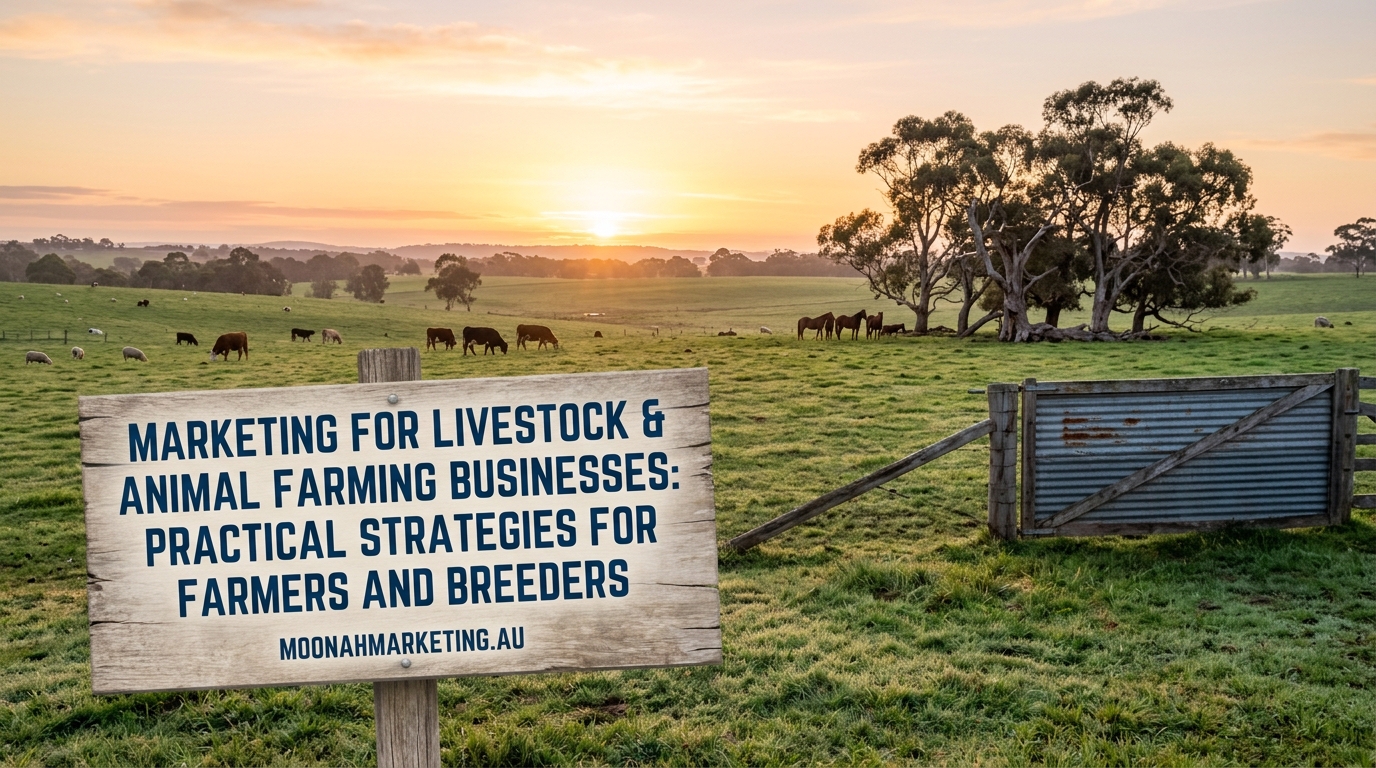

Marketing for Livestock & Animal Farming Businesses: Practical Strategies for Farmers and Breeders

Marketing for Livestock & Animal Farming Businesses: Practical Strategies for Farmers and Breeders Marketing a livestock or animal farming business isn’t quite the same as marketing most small businesses. Your customers may never visit the farm. They may be buying livestock, genetics, meat, milk, eggs, fibre or other products. They might be processors, agents, wholesalers, retailers, restaurants, other farmers or consumers buying directly from the producer. Some purchasing decisions happen regularly. Others can involve significant value, long-term breeding decisions or relationships built over many years. And while reputation has always mattered in agriculture, the way people research businesses has changed. A prospective buyer who hears about your property, stud or livestock operation may now search for you online before making contact. A consumer may want to know where their food comes from. A commercial buyer may be looking for a supplier with particular capabilities. Another producer may be researching breeding stock long before they’re ready to enquire. Effective marketing for livestock and animal farming businesses helps make sure they find the right information when they do. It isn’t about turning the farm into a content studio or spending every evening posting on social media. It’s about making your business easier to find, easier to understand and easier to trust. Start With Who You’re Actually Marketing To One of the most important questions for any animal agriculture business is: Who are we really trying to reach? A cattle breeder selling breeding stock to other producers has a very different customer journey from a free-range egg producer selling directly to households. A dairy business supplying a processor operates differently from a farm selling artisan dairy products under its own brand. A sheep operation may be marketing livestock, wool or breeding genetics. A poultry producer may deal primarily with wholesalers, retailers or food-service buyers. Your potential audiences could include livestock agents, processors, distributors, retailers, hospitality businesses, breeders, other farmers, export markets or end consumers. That means there is no single “livestock marketing strategy” that makes sense for everyone. Before deciding whether you need SEO, social media, email marketing, advertising or something else, get clear about who you want to influence and what they need to know before choosing you. Your Reputation Is Part of Your Marketing In animal agriculture, reputation can carry enormous weight. Buyers may care about the history of your operation, your breeding program, consistency, livestock quality, reliability, animal management practices, provenance or the experience of the people behind the business. Marketing shouldn’t try to manufacture that reputation. It should make the reputation you’ve already built easier for others to see. That might mean telling the story of how the farm began, explaining how your breeding program has developed, introducing the people behind the operation or documenting the standards and practices that matter to your customers. For a breeding enterprise, it might mean showcasing bloodlines, breeding objectives, sale results or progeny where appropriate. For a consumer-facing farm, it may mean explaining where products come from, how animals are raised and what distinguishes the business from alternatives. The key is specificity. “Quality livestock” says very little. Explaining why buyers return, what you select for, how long you’ve been operating or what your customers value about your stock gives people something meaningful to understand. Build a Website That Supports the Way You Sell Agricultural businesses have traditionally relied heavily on referrals, relationships, agents and industry networks. Those channels remain important, but they don’t replace the need for a strong digital presence. Someone may hear about your business at a sale, through another producer or from an agent, then immediately search your name online. What do they find? A good livestock or animal farming website should quickly explain what the business does, what it produces and who it works with. For a breeder or stud, that could include information about the breeding program, livestock for sale, sires or dams, genetics, upcoming sales and enquiry details. For a commercial livestock producer, the website might focus more on production capability, location, markets supplied, the history of the property and how buyers can make contact. For a farm selling directly to consumers, the website may also need product information, online ordering, stockists, delivery areas or farm-gate details. Photos matter too. Real photographs from the property, animals, team and operation can communicate far more than generic stock photography ever will. The goal isn’t necessarily to build a huge website. It’s to make sure that when someone looks you up, they can quickly understand who you are, what you produce and what they should do next. Use SEO to Be Found for More Than Your Business Name Many agricultural businesses are easy to find online if someone already knows their name. That’s useful, but SEO can go further. Potential customers may be searching for the type of producer, animal, breed or product they need. Depending on your business, searches might look something like: “Angus cattle breeder Victoria” “Dorper sheep breeder Australia” “free range egg producer Melbourne” “breeding bulls for sale Victoria” “local grass fed beef farm” “livestock breeder near me” The exact searches will depend on what you produce and how your customers buy. This is why specific website pages can be more useful than one generic page explaining that you’re a farm. If breeding stock is a major part of your business, give that part of the operation enough information online. If you specialise in particular breeds, products or markets, explain them. If location matters to customers, make your service area or region clear. Search engines need context to understand your business, and so do prospective customers. Tell the Story Behind the Animals Livestock and animal farming businesses naturally have a wealth of content available. The problem is often recognising that everyday farm activity can be interesting to someone outside the operation. You don’t need to manufacture elaborate campaigns every week. There may already be stories happening around: calving or lambing season, breeding programs, new arrivals, pasture management, sale preparation, animal care, farm improvements, seasonal conditions, staff,

Learn More

AI and Copyright in Australia: Why Jimmy Barnes, Paul Kelly and Other Musicians Are Speaking Out

AI and Copyright in Australia: Why Jimmy Barnes, Paul Kelly and Other Musicians Are Speaking Out Artificial intelligence is changing the way we create, communicate and do business. From generating marketing content to assisting with research and design, AI is becoming an increasingly familiar part of everyday professional life. But behind its extraordinary capabilities sits a question that is becoming increasingly difficult to ignore. Who should benefit when artificial intelligence is trained using somebody else’s creative work? In Australia, that question has become the centre of a significant dispute involving some of the country’s most recognisable musicians, major technology companies and the federal government. Jimmy Barnes, Paul Kelly, Peter Garrett and Mark Seymour are among the artists calling on Prime Minister Anthony Albanese to protect Australian music from being used for AI training without appropriate permission or payment. As reported by The Australian on 9 November 2026, the musicians have voiced concerns about the use of Australian recordings in AI training datasets and the potential weakening of protections for creators. Their concerns extend far beyond the recording industry. The outcome of Australia’s copyright debate could influence how photographers, writers, designers, publishers, filmmakers and other creative professionals protect the value of their work. And for businesses increasingly adopting AI tools, it’s a conversation worth understanding. Why Are Australian Musicians Challenging AI Companies? On 9 November 2026, prominent Australian musicians renewed calls for the federal government to protect copyrighted music from unauthorised AI training. The artists argue that recordings of their work have appeared in datasets associated with AI training without their permission or compensation. One particularly striking detail involves Prime Minister Anthony Albanese’s own musical preferences. According to the musicians, recordings of all ten songs on the Prime Minister’s list of favourite Australian tracks have appeared in datasets used by AI developers. It’s an uncomfortable coincidence for a political leader who has publicly celebrated Australian music. The very artists responsible for creating songs that have become part of our national culture are now asking the government to ensure their work retains meaningful legal protection. Their concerns are part of a wider debate about how AI companies obtain creative material and whether the people who create it should be compensated. The issue also extends into advertising and production. In a separate investigation, the Australian Financial Review reported on 8 November 2026 that composers Antony Partos and Nigel Westlake had raised concerns about musicians being asked to recreate AI-generated tracks for commercial use. These developments highlight how AI copyright questions are increasingly affecting the everyday work of creative professionals. What Does AI Training Have to Do With Copyright? Generative AI models are developed using large collections of information and creative material. Depending on the system, those collections may contain books, photographs, articles, audio recordings, illustrations, computer code and other content. During training, AI models learn patterns from the material they process. Those patterns help them generate new responses or outputs. As explained in APRA AMCOS’s guide to AI and music, generative AI can analyse existing music to learn patterns involving melody, structure, rhythm and other creative elements. The legal question is whether using copyright-protected material in this process requires authorisation from the copyright owner, and under what circumstances. This differs from the question of whether an individual AI-generated output infringes copyright. Training and output are connected, but they raise distinct legal and commercial issues. For Australian creators, the concern is that their work may contribute to the development of valuable commercial products without a meaningful opportunity to consent, negotiate terms or receive compensation. For AI developers, the challenge is obtaining workable access to large volumes of material while navigating complex copyright arrangements. Both concerns are relevant to the policy debate. The disagreement centres on how to balance them. The Difference Between Opt-In and Opt-Out AI Licensing One of the most consequential questions is who should be responsible for obtaining or withholding permission. Under an opt-in approach, AI companies generally need to secure permission or an appropriate licence before using protected material. Under an opt-out approach, certain material may be available for use unless the copyright owner takes action to exclude it, subject to the rules of the particular proposal. That difference may appear technical, but it has significant practical implications. Consider an independent Australian musician who has spent years developing a catalogue of original recordings. Under an opt-in system, the musician or relevant rights holder has an opportunity to determine whether their work should be licensed. Under an opt-out arrangement, the musician may instead need to understand which systems are collecting their work, identify how to register an objection and monitor whether that objection is respected. For a large organisation with legal resources, those responsibilities may be manageable. For an independent artist, they could become a substantial additional burden. The same concerns extend to photographers, illustrators, writers and smaller creative businesses. The Australian Independent Record Labels Association (AIR) outlined its concerns about copyright reform proposals, arguing that the rights of independent music businesses and creators should be protected as AI policy develops. What Is the Australian Government’s Position? Importantly, Australia has not introduced a broad AI training exemption into copyright law. In an official announcement on 26 October 2025, the Albanese Government confirmed it had ruled out a broad text-and-data-mining exception that would allow AI developers to use copyrighted material without permission. The government has continued examining copyright policy in response to emerging AI technologies, including questions about licensing, transparency and enforcement. The Attorney-General’s Department’s Copyright and Artificial Intelligence Reference Group provides information about the consultation process and the issues under consideration. These policy discussions should not be confused with changes already enacted into law. Different proposals may involve different arrangements, and their practical consequences depend on the final legal framework. As at 9 November 2026, the broader debate remains ongoing. Can AI Innovation and Creative Rights Coexist? The debate is sometimes presented as a choice between embracing technological innovation and protecting creators. I don’t believe that framing is especially helpful. AI

Learn More

The Eight-Star Washing Machine That Takes 25 Hours: What the 2026 Shonky Awards Reveal About Marketing and Consumer Trust

When Your Founder Becomes Your Biggest Brand Risk: Lessons From the Sam Wood Rebrand An eight-star energy rating would ordinarily be a compelling selling point for a household appliance. With electricity costs continuing to influence purchasing decisions, consumers have good reason to prioritise products that promise greater efficiency. However, one of the products recognised in CHOICE’s 2026 Shonky Awards demonstrates how an impressive marketing claim can tell only part of the story. A Hisense washer-dryer combination has attracted criticism after consumer advocacy group CHOICE highlighted that its most energy-efficient washing and drying programs take more than 25 hours to complete consecutively. While the appliance’s energy ratings comply with the relevant testing standards, the time required to achieve those results raises questions about how accurately product marketing reflects everyday consumer experiences. The appliance is among several products and services recognised in the 2026 Shonky Awards, which highlight practices CHOICE considers unfair, misleading or disappointing for Australian consumers. Beyond the entertaining headlines, this year’s awards offer an important examination of the relationship between advertising claims, consumer expectations and brand reputation. For businesses of every size, they reinforce a fundamental marketing principle: a claim can be technically accurate without necessarily providing customers with a realistic understanding of what they are purchasing. When an impressive product claim doesn’t tell the whole story The Hisense Series 8i Heat Pump Washer Dryer Combo demonstrates the distinction between compliance with testing standards and the practical value of a product’s advertised features. According to CHOICE, the appliance’s energy-efficient drying program takes approximately 13.5 hours to complete, while the washing program associated with its five-star washing rating requires more than 12 hours. Together, the programs take more than 25 hours, a timeframe that may be impractical for households purchasing a combination appliance partly for its convenience. Importantly, the energy ratings themselves are not necessarily inaccurate. Hisense has indicated that the appliance was tested according to the applicable Australian and New Zealand standards, which allow manufacturers to nominate particular programs for energy-efficiency testing. The concern lies in the relationship between the advertised benefit and the conditions required to achieve it. An energy rating provides useful information about a product’s performance under standardised testing conditions. However, consumers may reasonably interpret a highly efficient washer-dryer as an appliance that delivers both energy savings and practical everyday performance. If achieving the advertised efficiency requires substantially longer operating times than expected, that distinction becomes relevant to the purchasing decision. This illustrates a broader challenge in product marketing. Businesses frequently promote measurable advantages such as efficiency, speed, durability or cost savings, but those claims can lose their practical meaning when important qualifications are not communicated effectively. The strongest marketing communicates not only what a product can achieve, but also the circumstances in which customers can reasonably expect those results. The gap between business policies and customer expectations Other recipients of the 2026 Shonky Awards demonstrate how dissatisfaction can arise even when businesses operate within established policies and contractual arrangements. Virgin Australia was recognised over the expiry of unused COVID-era flight credits. CHOICE highlighted the airline’s recognition of approximately $75 million in expired credits, representing money associated with travel bookings that customers had not ultimately used. Virgin Australia has defended its handling of the credits, stating that more than 93 per cent were redeemed and pointing to the extensions and communications provided to affected customers. Nevertheless, the issue illustrates how differently businesses and consumers can interpret the same transaction. From an operational perspective, a company may consider an obligation fulfilled once the relevant conditions, deadlines and notifications have been applied. Customers, however, are more likely to evaluate the experience according to whether they received reasonable value for the money they originally spent. Ticketing companies Ticketek and Ticketmaster also attracted criticism, with CHOICE raising concerns about pricing practices associated with popular events. Among the examples highlighted were NRL tickets offered at substantially higher prices than comparable nearby seats. While ticketing companies have defended their pricing arrangements, including the role of event organisers in determining prices, the criticism reflects a wider consumer concern about transparency and purchasing pressure. For customers attempting to secure tickets to a popular event, the combination of limited availability, virtual queues and variable pricing can make it difficult to evaluate whether an offer represents reasonable value. These examples involve different industries, products and commercial arrangements, yet they share a common issue. The customer’s perception of fairness is not determined solely by whether a business has complied with its stated conditions. It is also shaped by how clearly those conditions were communicated and whether the resulting experience matched reasonable expectations. Why transparency has become a competitive advantage Marketing has traditionally focused heavily on attracting attention, communicating benefits and encouraging customers to take action. While these remain essential functions, increasingly informed consumers also expect businesses to explain the conditions and limitations associated with their offers. This expectation has particular significance in digital environments, where customers frequently compare products, consult independent reviews and investigate competing claims before making purchasing decisions. Transparency can influence the entire customer relationship, from the first interaction with an advertisement through to the experience of using a product or service. A business that communicates limitations openly may initially appear less persuasive than a competitor promoting only its strongest selling points. However, realistic expectations can contribute to better purchasing decisions, fewer misunderstandings and more positive customer experiences. Consider a service provider advertising a rapid turnaround time. If that timeframe applies only to straightforward jobs under particular conditions, communicating those qualifications helps customers assess whether the service meets their needs. Similarly, an online retailer promoting fast delivery should make geographical restrictions or processing delays readily accessible rather than relying on customers to discover them during checkout. The objective is not to overwhelm prospective customers with technical details or lengthy disclaimers. Effective communication requires businesses to identify which information is material to a purchasing decision and present it in a way that is accessible and understandable. In Australia, this principle also has a regulatory dimension.

Learn More